Caesar Auto-staking Protocol or CAP

Introduction
Caesar is a developer based company focused on innovation that creates benefits and value for Caesar token holders. Our CAP protocol is issued in the Caesar token giving it exception benefits for holders of $CAESAR:
Easy and Safe – We provide auto-staking right in your wallet when you purchase $CAESAR. No need to move your tokens to our website. From the minute you buy, you are staked, and set to receive rebase rewards. The easiest auto-staking in DeFi.
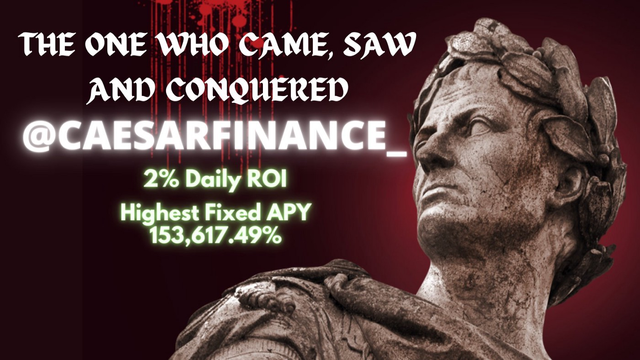
A Fixed APY – APYs that fluctuate means you can never tell how many tokens you will receive. Other DeFi protocols pay out a high APY that can fluctuate by 90% in a day. CAP pays $CAESAR holders a fixed interest rate of just over 2% daily or with compounding 153,617.5% annually.
Fast Rebase Rewards. Other popular staking protocols pay rebasing rewards every 8 hours which means if you want to unstake you have to time it to get maximum rewards. The Caesar Auto-staking Protocol pays every 30 minutes or 48 times every day, making it the fastest auto-staking protocol in crypto.
The CAP uses a complex set of factors to support its price and the rebase rewards. It also uses game theory and human nature to determine the most likely habits of those who buy the token. Our development team has coordinated all of these elements so they work seamlessly behind the scenes. The result is a simple and elegant staking and rewards system for $CAESAR holders.
The CAP is as flexible as it is powerful and will be used as the foundation for a range of Caesar products, services, and projects going forward. Each will transform a different area of crypto
Here's how it works: by simply buying $CAESAR and holding the token in your wallet, you earn rebase rewards directly into your wallet. Your tokens will increase every 30 minutes. It's that simple.
Using a Positive Rebase formula, Caesar makes it possible for daily token distribution directly proportional to the daily rebase rewards, worth 2% of the token supply.
The rebase rewards are distributed on each epoch (rebase period) to all $CAESAR holders. This means that without moving their tokens from their wallet, Caesar holders receive an annual compound interest of 153,617.5%. Pretty crazy.
FEATURES
Auto staking : The CAP Autostake feature is a simple yet cutting-edge function called Buy-Hold-Earn, that provides the ultimate ease of use for $CAESAR holders.
- Rabase Token : A Rebase Token is one whose circulating supply expands or contracts due to changes in the token price. This increase or decrease in supply works with a mechanism called rebasing.When a rebase occurs, the supply of the token is increased or decreased algorithmically, based on the current price of each token.
Risk-Free Value (RFV) : Risk-Free Value (RFV) is a separate wallet in Caesar’s CAP system. The RFV uses an algorithm that backs the Rebase Rewards and is supported by a portion of the buy and sell trading fees that accrue in the RFV wallet.
- Treasury : The Treasury plays a very important role in Caesar’s CAP protocol. It provides three extremely critical functions for the growth and sustainability of Caesar.The Treasury is dedicated to buy backs and burns of the $CAESAR tokens when the AVAX/CAESAR pair supply is equal to or greater than 2.5% of the total supply.
- APY : APY stands for Annual Percentage Yield. This measures the real rate of return on your principal tokens amount by taking into account the effect of compounding interest.In this case, your $CAESAR tokens represent your principal, and the compound interest is added periodically every rebase (which is every 30 minutes).

TOKENOMICS
Set up the Avalanche network on your MetaMask account and send your C-Chain AVAX. Follow this guide: https://docs.traderjoexyz.com/main/welcome/joes-guide-to-avalanche/metamask-tutorial#connect-metamask-to-avalanche. If you don’t have a MetaMask account, make one here: https://metamask.io/
Swap your AVAX for $CAESAR here. When swapping, set your slippage to 15%, and continuously increase until your transaction goes through. You will rarely need to go 5% above the minimum 15% slippage fee, but launch could require higher slippage.
Author
Komentar
Posting Komentar